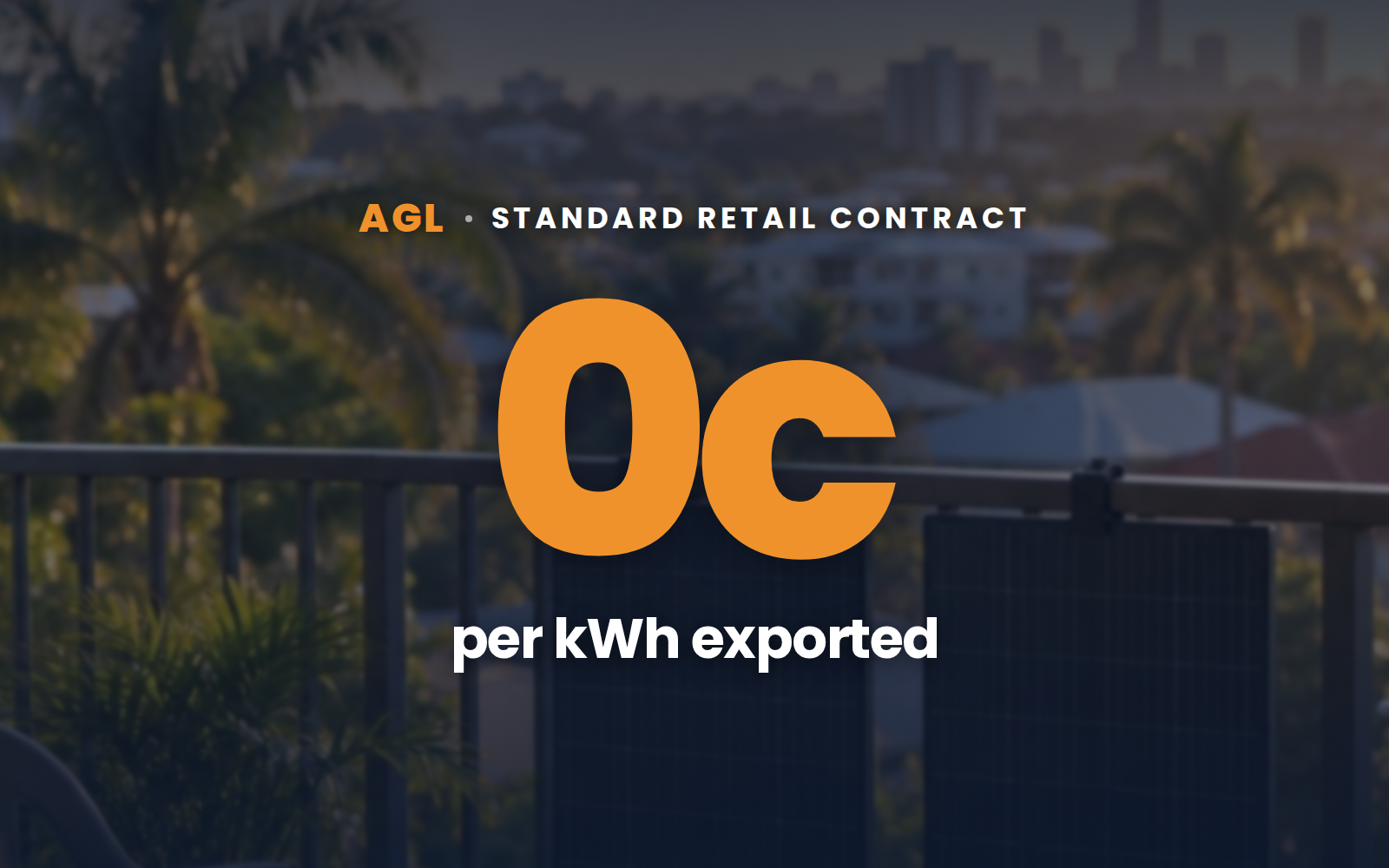
A zero-cent solar feed-in tariff sounds like a simple verdict: your panels are no longer worth it.
That is not what it means.
AGL says customers on its Standard Retail Contract will not receive a solar feed-in tariff from 1 July 2026. But this does not automatically apply to every AGL customer. Your plan, location and contract determine what rate appears on your bill.
The first move is not to buy a battery or rush to switch retailers. It is to check which plan you are actually on.
What changed on 1 July 2026?
A solar feed-in tariff (FiT) is the credit a retailer may pay for surplus electricity your panels export to the grid. It is separate from the price you pay when you import electricity, and separate from the daily supply charge.
AGL's current solar FiT guidance says customers on its Standard Retail Contract receive no FiT from 1 July 2026. The same page explains that, where a FiT applies, its rate can depend on your state, electricity plan, time of day and whether a government scheme applies.
That distinction matters. “AGL customer” is not the same thing as “AGL Standard Retail Contract customer”. Some AGL market offers may still include an export rate. The amount and eligibility can vary, and rates can change with notice.
How to check whether your household is affected
Start with your latest electricity bill and your AGL account. Look for the plan or contract name, then find the solar export or feed-in credit line.
Check these three things:
- Your plan name: Does it say Standard Retail Contract, or does it name a market offer?
- The export credit: Is the FiT shown as 0c, or is a rate listed? Check the unit and billing period.
- Your exported energy: How many kilowatt-hours did you send to the grid, and what credit did that actually produce?
If the bill is unclear, ask AGL to confirm in writing which contract you are on and what FiT applies to your address. Do not assume a rate you saw in an advertisement, comparison table or neighbour's bill applies to your property.
The number on your own bill and current contract is the one that matters.
A high headline rate can come with limits
A market offer may advertise a higher rate for exported solar, but read the conditions. Some plans cap the higher rate at a set amount of daily exports, then pay a lower rate on the rest. Others have different usage prices, supply charges or time-of-use windows.
For example, AGL's Solar Savers information currently describes an 8c/kWh FiT for the first 8kWh of daily exports, averaged across the relevant billing period, and 3c/kWh for exports beyond that. The plan also has eligibility conditions, and rates can change. Treat this as an example of how a plan can be structured, not a promise that the same offer is available to every Queensland address.
Compare the whole bill, not one attractive line. A plan paying a few cents more for exports can still cost more overall if its usage rates or daily supply charge are higher for your household.
What a 0c FiT does and does not mean
If your FiT is zero, exported electricity earns no feed-in credit under that plan. It does not mean your solar system has stopped working, that every unit your panels generate is worthless, or that you must disconnect your system.
Solar power used in the home can still reduce the electricity you would otherwise buy at that moment. The practical question is how much of your generation you use while it is being produced, and how much you export.
A simple first step is to shift flexible use into solar hours when it suits your household: run the dishwasher or washing machine during the day, heat water when solar is available, or charge an EV during the solar window if your setup and routine allow it.
These changes will not suit every household, and they do not replace checking your plan. They are ways to make better use of energy you already generate.
Should you switch plans or add a battery?
Maybe, but neither decision should be made from the FiT number alone.
When comparing plans, look at your actual usage, export volume, supply charge, import rates and any time-of-use periods. The Australian Energy Regulator's Energy Made Easy service is a free, independent comparison tool for Queensland households. Use your address and bill data where possible, then confirm the final offer and conditions directly with the retailer.
A battery may let a household store some midday surplus and use it later, but the result depends on the household's load profile, solar production, battery capacity, system compatibility, tariff and how the battery is operated. A zero FiT by itself does not prove a battery will pay back for your home.
If you consider a virtual power plant (VPP), read what control the operator gets, how much charge is reserved for your home, what rewards are actually guaranteed, and how the agreement handles battery use and leaving the program. Do not trade away backup capacity or flexibility without understanding the terms.
The right comparison is the likely whole-house bill under each option, not “0c FiT versus battery” in isolation.
A practical checklist for AGL solar owners
Before changing anything:
- Confirm whether your contract is Standard Retail or a market offer.
- Check the FiT and exported kWh on a recent bill.
- Ask AGL which current offers are available for your address and system.
- Compare annual costs, including usage rates and supply charges, using your own consumption data.
- Only then assess whether load shifting, a battery or a VPP fits your home.
AGL's solar FiT page and plan terms can change, so verify the details before switching. The Energy Made Easy comparison service can help Queensland households compare available plans independently.
The real question
The end of a feed-in credit can feel like the end of the value in your solar system. It is not.
But it does make one thing more important: knowing where your solar energy goes, what your retailer pays for exports, and what you pay when your home needs power later.
If the FiT on your bill is 0c, do you know which plan you are on and what the best next move is for your household?
Sources
- AGL: Solar feed-in tariffs
- AGL: Solar Savers plan details
- Australian Energy Regulator: Energy Made Easy
Find Out What Your Solar Could Save You
Every home uses energy differently. We can review your bill, current solar setup and usage pattern to show where your exports are going and what options may suit your household.
No generic packages. Just a free assessment based on your home and your numbers.