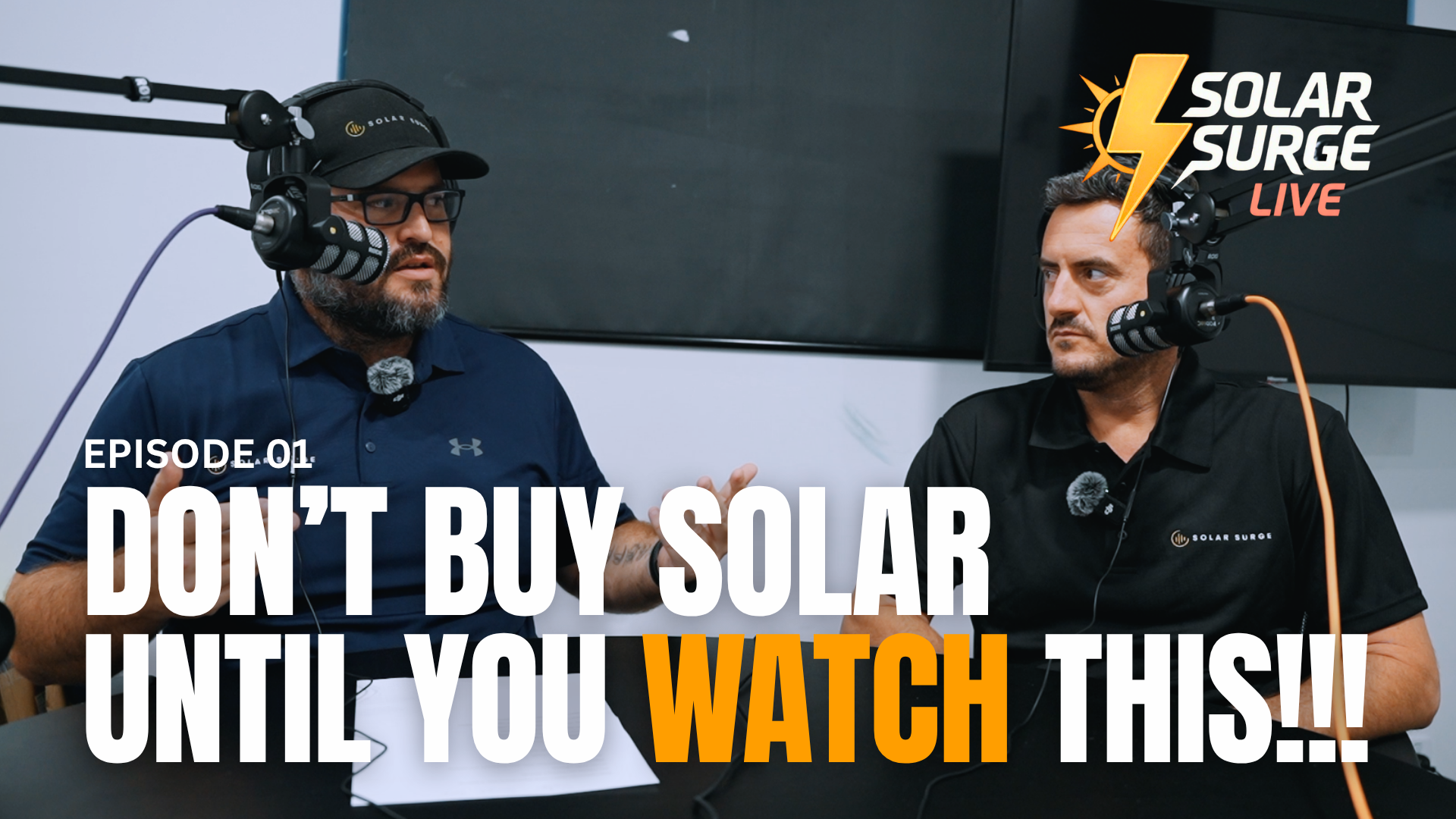
Thinking about installing solar panels or a home battery system in Australia? Before you sign any contracts or hand over your hard-earned money, you need to hear the brutal truth about the industry. In the premiere episode of Solar Surge Live, Andrew (Managing Director) and Luke (Qualified Technical Expert with 20+ years of electrical experience) sat down to expose the pitfalls of the current market and share exactly how homeowners can protect themselves from getting ripped off. Here is your ultimate guide to navigating the solar market without becoming a victim of cowboy installers.
1. The Boom of the Battery Market (and the 1,200% Grid Rip-Off)
If you've noticed everyone on your street installing batteries lately, it’s not just a trend—it's a financial necessity. Years ago, early adopters enjoyed high feed-in tariffs (getting paid up to 50¢ per kWh for sending solar power back to the grid). Today, that tariff has crashed to a miserable 2¢ to 3¢ per kWh.
Think about the math for a second:
- You sell your excess daytime solar power to the grid for 2¢.
- Two hours later, when the sun goes down, you "rent" power back from your provider for 42¢.
⚠️ The Reality Check: That is a 1,200% return on YOUR money going straight into the pockets of the electricity providers.
Unless you are storing your daytime energy in a home battery system, you are essentially donating your electricity. A battery allows you to become truly self-sufficient and keep your power where it belongs: in your home.
2. Price vs. Compliance: The Terrifying Risk of "Cheap Solar"
It is incredibly tempting to browse the market and choose the lowest quote. However, in the solar industry, cheap price tags equal dangerous shortcuts. When you buy from a massive "marketing-only" company that relies on outsourcing to the cheapest subcontractors, you aren't just getting a messy install. You are risking major safety hazards, including arcing.
- What is arcing? Imagine two live electrical points crossing over, creating miniature lightning bolts inside your walls or roof.
If your cables are poorly terminated or insulated, arcing will eventually cause a devastating electrical fire.
The Ultimate Catch-22: Voided Warranties
Many homeowners assume, "Even if the install is bad, at least the product has a warranty." Wrong. If a manufacturer inspects a faulty battery and discovers it was installed in a non-compliant manner, they will void your warranty immediately. You will be left with a broken system, an unsafe home, and thousands of dollars down the drain.
3. The Shocking QLD Audit: 50+ Installers BANNED
Think the threat of dodgy installers is exaggerated? Think again.
During a recent government safety audit right here in Queensland, over 50 solar installers and companies had their licenses stripped or suspended due to severe non-compliant battery installations.
The market moves fast, and when government rebates drop, "cowboy" companies flood the market to chase quick cash, switch off their phones when things go wrong, and leave behind "orphan" customers with zero after-care support.
4. How to Future-Proof Your System (Stop Sizing for Today)
Another massive issue in the industry is wrong system sizing. Unethical salespeople will look at your current electricity bill and sell you a tiny system just to make a quick, cheap sale that looks good on paper.
At Solar Surge, we don't believe in cookie-cutter reports. You must size your system for your future lifestyle. When planning your solar and battery capacity, always ask yourself:
- Am I planning to buy an Electric Vehicle (EV) in the next 2-3 years?
- Am I installing a swimming pool or a sauna?
- Am I upgrading my kitchen to an induction cooktop?
- Is my family growing, or are adult kids moving back home?
Adding high-draw appliances down the road to an undersized solar system will instantly blow out your electricity bill again.
📋 The Solar Surge 3-Step Protection Checklist
Before you let anyone mount panels on your roof, demand proof of these three credentials:
- Electrical Contractor’s License: Make sure the company selling you the system is a licensed electrical contractor, not just a marketing agency. Check their license number on the government portal.
- NETCC Approval: Ensure they are approved by the New Energy Tech Consumer Council (NETCC), proving they abide by a strict consumer protection code of conduct.
- Smart Energy Council Membership: Look for companies that are Essential Members of the Smart Energy Council, showing they are actively invested in lifting industry standards.
- Smart Energy Council Membership: Look for companies that are Essential Members of the Smart Energy Council, showing they are actively invested in lifting industry standards.
Watch the Full Episode
Want to see the full breakdown, including Luke's technical insights and real-world customer stories? Watch Episode 01 of Solar Surge Live natively on our channel.
Need an honest assessment of your home’s solar potential? Don't gamble with your family's safety. Contact the team at Solar Surge Australia today for a transparent, personalized quote built on 20+ years of elite electrical expertise.
🌐 Visit us: www.solarsurge.com.au
Frequently Asked Questions
What should I check before signing a solar or battery contract in Australia?
Ask for three credentials in writing. The company's own electrical contractor's licence number, which you can verify on the government portal. NETCC approval from the New Energy Tech Consumer Council, which binds them to a consumer protection code of conduct. And Smart Energy Council membership.
Why are so many Australian households adding batteries now?
Because the export economics collapsed. Feed-in tariffs that once paid up to 50 cents per kWh now sit around 2 to 3 cents, while power bought back after sunset can cost about 42 cents. Without storage, daytime solar is effectively donated to the retailer.
What actually goes wrong with a cheap solar install?
The most serious risk is arcing. When cables are poorly terminated or insulated, live electrical points can cross and create discharge that builds heat inside a roof or wall cavity, which can eventually cause an electrical fire.
Does the manufacturer warranty still apply if the installation was non-compliant?
Often not. If a manufacturer inspects a faulty battery and finds it was installed in a non-compliant manner, the warranty can be voided, leaving the homeowner with an unsafe system and no cover for it.
How common are unlicensed or non-compliant solar installers?
In a recent Queensland government safety audit, more than 50 solar installers and companies had their licences stripped or suspended because of severely non-compliant battery installations.
How should I size a solar and battery system?
Size it for your future lifestyle rather than today's bill. Consider whether an EV, a pool, a sauna, an induction cooktop or a growing household is likely in the next few years, because adding high-draw appliances to an undersized system pushes the bill straight back up.